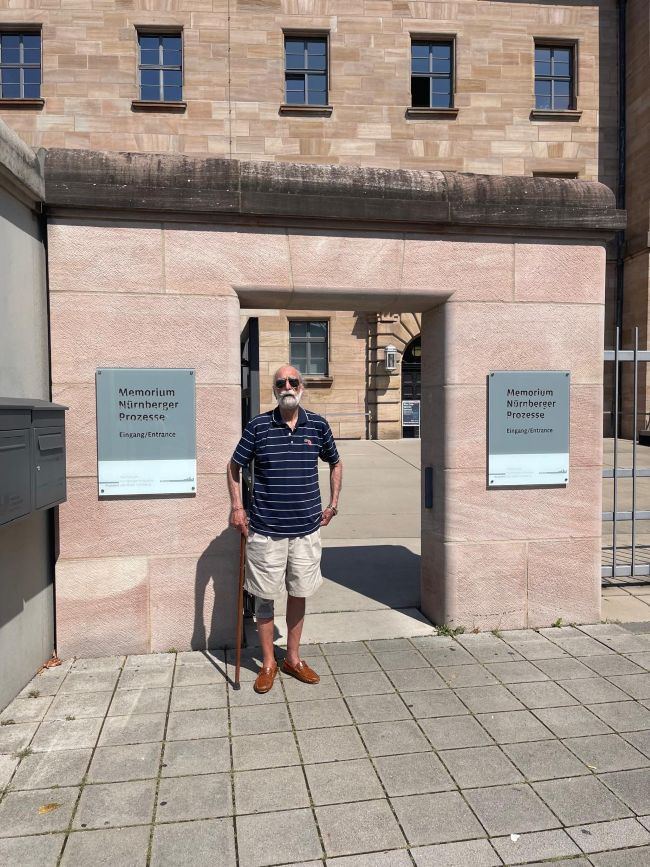
Introduction
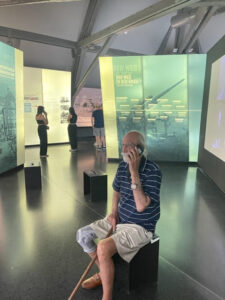
Why Nuremberg?
After Germany’s surrender in May 1945, the Allied powers—the United States, the United Kingdom, the Soviet Union, and France—decided that leading Nazi officials must face trial. Nuremberg was chosen because it was home to the impressive Palace of Justice, a courthouse complex largely undamaged by bombing and equipped with an adjoining prison. Symbolically, Nuremberg had hosted massive Nazi Party rallies; its selection turned the former stage of tyranny into a courtroom for justice.
The Palace of Justice and Courtroom 600
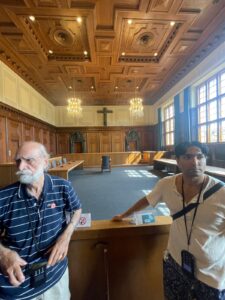
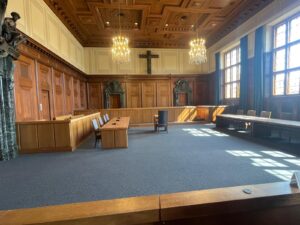 Built between 1909 and 1916 on Fürther Straße, the Palace of Justice comprised multiple court buildings, offices, and a secure prison. Its most famous chamber, Courtroom 600, became the site of all main trial sessions. The room was modified to include simultaneous-translation booths, microphones, and recording systems—pioneering technology that allowed proceedings in English, German, French, and Russian. The building’s architecture—high ceilings, oak panels, and large windows—conveyed solemn authority. It could accommodate judges, prosecutors, defense teams, defendants, journalists, and observers from around the world. Today, Courtroom 600 is preserved as the Memorium Nürnberger Prozesse (Nuremberg Trials Memorial), a museum reminding visitors how justice replaced barbarity in the very heart of Germany.
The Legal Framework: The London Charter
The trials operated under the London Charter of the International Military Tribunal, signed on 8 August 1945. It defined four categories of crimes:
- Crimes Against Peace – Planning and waging aggressive war.
- War Crimes – Violations of the laws and customs of war.
- Crimes Against Humanity – Murder, enslavement, deportation, or persecution of civilians.
- Conspiracy – Participation in a common plan to commit the above crimes.
Presiding Judge
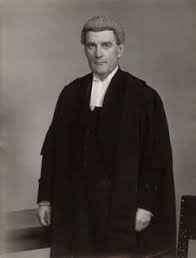 Lord Geoffrey Lawrence, 1st Baron Oaksey, served as the Presiding Judge (President) of the International Military Tribunal at the Nuremberg Trials (194 5–46). A distinguished British jurist, he guided the historic proceedings with fairness, patience, and dignity, ensuring justice prevailed amid intense political pressures. Lawrence managed the complex trial of 22 leading Nazi war criminals, maintaining order and impartiality throughout months of testimony. His calm authority and commitment to due process earned respect from all sides. Under his leadership, the tribunal delivered landmark judgments that redefined international law, establishing accountability for crimes against peace, war crimes, and crimes against humanity.
The Tribunal Prosecutor
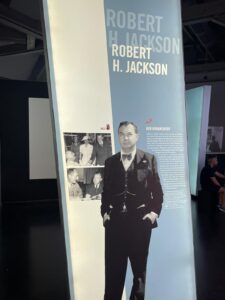 Robert H. Jackson (1892–1954) was a distinguished U.S. Supreme Court Justice and Chief U.S. Prosecutor at the Nuremberg Trials. Born in Pennsylvania and largely self-taught in law, he rose through Franklin D. Roosevelt’s administration to become Attorney General and later a Supreme Court Justice (1941–1954). On the Court, he championed civil liberties, notably in West Virginia v. Barnette (1943). At Nuremberg, Jackson led the prosecution of Nazi leaders, establishing principles of international justice that endure today. His eloquence, integrity, and belief in the rule of law made him one of America’s greatest jurists and global defenders of justice.
The Tribunal Defender
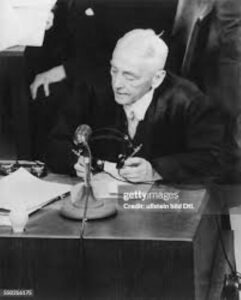 Hermann Göring at the Nuremberg War Crimes Trials (1945–1946). Born in Hamburg, he was known for his professionalism, composure, and legal acumen. At Nuremberg, Stahmer faced the immense challenge of representing one of Hitler’s top aides before the Allied tribunal. He argued that Göring’s actions stemmed from patriotism rather than criminal intent. Despite his skilled defense, Göring was convicted and sentenced to death. After the trials, Dr. Stahmer resumed his law practice in Germany, maintaining a ected reputation until his death in 1968.
The Tribunal and the Defendants
The International Military Tribunal (IMT) consisted of judges and prosecutors from the four Allied powers. Twenty-four major Nazi leaders were indicted. Among them:
- Hermann Göring – Head of the Luftwaffe and Hitler’s deputy: sentenced to death, but committed suicide before execution.
- Joachim von Ribbentrop – Foreign Minister: death.
- Wilhelm Keitel – Chief of Armed Forces: death.
- Albert Speer – Armaments Minister: 20 years’ imprisonment.
- Karl Dönitz – Navy Admiral: 10 years’ imprisonment.
- Hjalmar Schacht and Franz von Papen – acquitted.
The hearings opened on 20 November 1945 and concluded on 1 October 1946. Eleven defendants were executed, several imprisoned, and three acquitted.
Hermann Göring: The Defiant Defendant
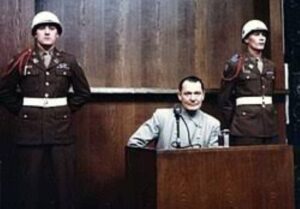 Hermann Göring, once Adolf Hitler’s designated successor and head of the Luftwaffe, emerged as the most defiant defendant during the Nuremberg Trials. Intelligent, articulate, and unrepentant, he used the courtroom as a platform to justify Nazi ideology and challenge the authority of the Allied judges. Göring’s sharp wit and commanding presence initially impressed observers, but his arrogance and refusal to show remorse exposed his moral corruption. He defended his actions as patriotic duty, denying guilt for the regime’s atrocities. Convicted of war crimes and crimes against humanity, Göring was sentenced to death but evaded execution by committing suicide with cyanide.
Principles Established
- Individual Responsibility: Individuals—not just states—can be punished under international law.
- No Immunity for Leaders: Official position does not exempt anyone from accountability.
- “Following Orders” Is No Defense: Obedience to unlawful commands cannot justify atrocities.
- Recognition of Crimes Against Humanity: Systematic persecution of civilians is punishable worldwide.
Criticism and Controversy
 The trials were not free from criticism. Some labeled them “victors’ justice,” arguing that Allied actions were never similarly judged. Others objected that the crimes were defined after they occurred, violating the principle of nullum crimen sine lege—no crime without law. Yet, despite such debate, Nuremberg established enduring moral and legal standards that no nation could ignore.
Legacy of the Nuremberg Trials
The Nuremberg Trials paved the way for later tribunals on Rwanda, Yugoslavia, Sierra Leone, and ultimately the International Criminal Court (ICC) in 2002. Their core message remains timeless: leaders who unleash war or persecute civilians can and will be held accountable.
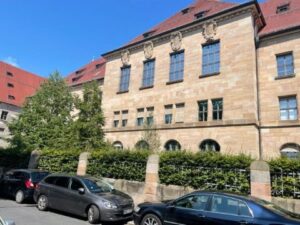 The Palace of Justice still functions as a courthouse, but part of it stands as a memorial. Visitors to Courtroom 600 sense the gravity of the moment when civilization put tyranny on trial. The room where dictators once dreamed of world domination became the stage on which justice reclaimed its voice.
Conclusion
The Nuremberg Trials transformed vengeance into law and set a global precedent for accountability. Within the solemn walls of the Palace of Justice, humanity confronted its darkest hour—and declared that such crimes would never again go unpunished. The courage of the judges, prosecutors, and witnesses ensured that even in the aftermath of unimaginable horror, justice prevailed.
“Crimes against international law are committed by men, not by abstract entities.” — Nuremberg Judgment, 1946