COLONEL PRITHIJIT SINGH VOHRA
Soldier, Administrator, Historian and Custodian of Family Heritage
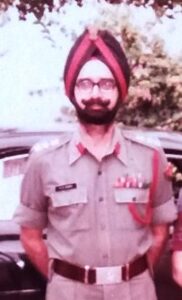
Commissioned into the Indian Army in 1957, Colonel Vohra served the nation for three decades during a period that witnessed major military and national developments. During his career he held a variety of command, staff and administrative appointments and participated in both the 1965 and 1971 Indo-Pak Wars.
His professional reputation was built upon meticulous administration, sound logistics management, dedication to duty and the ability to deliver results under demanding circumstances. These qualities earned him the confidence and appreciation of senior commanders throughout his service.
Recognition by Senior Commanders
One of the most significant testimonials to Colonel Vohra’s professional abilities was received upon his departure from 11 Infantry Division as Commander Army Ordnance Corps (CAOC) in April 1979.
In a personal letter dated 2 April 1979, Major General Ranjit Singh Dyal, MVC, (former GOC 11 Inf Div), Chief of Staff, Headquarters I Corps, wrote:
“You played a key role in giving me confidence in my Division’s ability to perform the impossibles.”
General Dyal further recorded:
“You also deserve my most profuse thanks for your performance as the Station Commander.”
These remarks reflected the high regard in which Colonel Vohra was held by one of the Indian Army’s most respected senior officers.
The same letter also acknowledged the contribution made by Mrs. Prithi Vohra towards the welfare and social life of the military station, demonstrating the important role played by Army families in supporting military communities.
Posting to the Army Ordnance Corps School
In April 1979, Colonel Vohra was posted as Assistant Adjutant and Quartermaster General (AA & QMG) at the Army Ordnance Corps School, Jabalpur, one of the Indian Army’s premier training establishments.
During this period the institution was under the command of Major General H. M. Thacker and Brigadier I. R. K. David.
The appointment carried extensive responsibilities relating to administration, logistics, infrastructure, ceremonial functions and institutional development.
The Kangla Tongbi War Memorial
Kanglatongbi War Memorial is located about 25 km north of Imphal on the Imphal–Kohima Highway.
The memorial commemorates the gallant action of the 221 Advance Ordnance Depot (AOD) during the Battle of Kanglatongbi on 6–7 April 1944 in World War II. A small group of Army Ordnance personnel successfully delayed a much larger Japanese force, helping protect vital military supplies and contributing to the defense of Imphal.
Originally built in 1946 and later renovated by the Indian Army, the memorial honors the 19 soldiers who laid down their lives in the battle.
The Kanglatongbi battle is regarded as one of the finest examples of courage and sacrifice in the history of the Army Ordnance Corps.
Colonel Vohra’s Contribution
Among the most important projects undertaken during Colonel Vohra’s tenure was the construction and inauguration of the Kangla Tongbi War Memorial.
The memorial commemorates the gallant actions and sacrifices of Army Ordnance Corps personnel during the historic Battle of Kangla Tongbi in 1944 during the Burma Campaign of the Second World War.
The project demanded careful planning, close coordination and completion within a limited timeframe. Colonel Vohra was entrusted with major responsibilities in ensuring the successful completion of the memorial and the organization of its inauguration ceremony.
The memorial was formally inaugurated on 20 February 1982 by Lieutenant General S. S. Sandhu, PVSM, Director of Ordnance Services.
Following the inauguration, Lieutenant General Sandhu addressed a letter of appreciation to Major General H. M. Thacker, Commandant, AOC School.
In that letter he wrote:
“I write this letter to thank you and through you the officers, JCOs and OR of AOC School for the splendid work done in ensuring the proper construction of the War Memorial at Jabalpur.”
He further observed:
“The inauguration ceremony arranged by you was indeed very befitting to the memory of those who had laid down their lives.”
The appreciation from Army Headquarters constituted official recognition of the successful completion of an important project in the history of the Army Ordnance Corps.
Appreciation from Major General H. M. Thacker
Following receipt of the above communication, Major General H. M. Thacker personally forwarded the appreciation to Colonel Vohra.
In his letter dated 6 March 1982, General Thacker recorded:
“This has been possible entirely due to your hard work and dedication.”
He further stated:
“I am sure, the Memorial would never have been ready in time but for your persistent and untiring efforts, and the credit rightly goes to you.”
These remarks remain among the most valued recognitions received by Colonel Vohra during his military career and constitute an enduring record of his contribution to the successful completion of the Kangla Tongbi War Memorial.
Life After Retirement
Following retirement from the Indian Army in 1987, Colonel Vohra continued to serve in a different capacity: as a preserver of history and family heritage.
Recognising the importance of recording the achievements and memories of earlier generations, he undertook the creation and maintenance of The Vohras website.
The website documents the history, genealogy and military traditions of the Vohra family and preserves valuable records, photographs, biographies and historical narratives for future generations.
The Vohra Veterans section in particular serves as a tribute to family members who served in uniform over many generations and reflects Colonel Vohra’s commitment to preserving their legacy.
Legacy
The life of Colonel Prithijit Singh Vohra demonstrates that service to the nation does not end with retirement.
His military career, his contribution to the Army Ordnance Corps School, his role in the creation of the Kangla Tongbi War Memorial, and his dedication to preserving family and military history together form a legacy of service extending over more than six decades.
Today, the memorial at Jabalpur, the documents preserved from his service, and the family archive he created stand as enduring reminders of a life dedicated to duty, remembrance and the preservation of history.